
Very British Problems
Thoughts on whether a new prime minister will find a cure Britain's pathologies, what the gilt market says about British institutions, and the winners and losers in the AI race


This week’s newsletter is a Trump-free zone. As expected, he went to Beijing with a weak hand and played it badly, but it is too soon to judge the consequences. This post is free to read, thanks to a sponsor. Please do click on the links. Many thanks as always to paid subscribers. If you find these posts helpful, please do consider joining them. At the very least, do hit the like button and forward it to anyone you think might be interested. I look forward as always to your comments and feedback.
Ungovernable Britain: Pathological Problems
Gilty Verdict: Incredible regime
AI Race: Winners and Losers
1. Ungovernable Britain
It now seems very likely that Sir Keir Starmer will be out as British prime minister before the year is out. Much depends on whether Andy Burnham, apparently the favourite among Labour members to succeed him, can win a parliamentary seat in Makersfield — a task that looked hard enough before Wes Streeting turned the by-election into a mini-referendum on Brexit.
Peter Kellner reckons Burnham’s strong local support should be enough to carry him through. Still, the fate of Patrick Gordon Walker, the former Labour foreign secretary, who tried to return to parliament in a specially engineered byelection after losing his seat in the 1964 general election serves as a warning that British voters don’t appreciate being taken for granted.
But will a change of prime minister pull Britain out of the deep hole in which it increasingly finds itself? There has been much debate in the UK media over the past couple of weeks as to whether Starmer’s misfortunes show that Britain has become ungovernable. Some argue that his fate reflect his own manifest failings as a politician who is unable to land a compelling argument or to recruit and retai a team. Others argue that Britain is hardly alone in experiencing political fragmentation and rising populism, so it is unfair to blame Labour.
There is truth in both analyses. But as I noted in my latest column for Euractiv, neither captures the full depth of Britain’s malaise. What has made the country seemingly ungovernable is the failure of its political class to grapple with two uniquely British pathologies that have hung over its politics for at least a decade:
The first stems from the collapse of the Thatcherite economic model. Decades of privatisation and, more recently, austerity have left Britain’s public services starved of investment and badly performing, fuelling intense public frustration. At the same time, an obsession with keeping taxes low has contributed to a situation in which debt is approaching 100% of GDP and the government has run a budget deficit of 4.3% of GDP – hence the gilt market flashing red.
The core of Britain’s problem is that the public demands European standards of public services while being willing to pay only American levels of tax. That tension is no longer sustainable, particularly with new spending pressures looming from demographics, the energy transition and defence.
Indeed, Erik Fossing Nielsen spelt out the numbers in his post last week. He noted that the British government spends about 43 percent of GDP on public services, investment and interest payments but collects only around 39% of GDP in taxes. This is a lot less than other major European countries collect in taxes (or spend): Germany taxes 48% of GDP, France 52%, Italy 47%, and Spain 42% — an all of these run deficits at, or below, the UK level.
In other words, the UK government taxes the economy by almost 9pp of GDP less than e.g. the German government. Yet, if opinion polls and election results are to be believed as an indication of the services demanded by the population, the Brits are not happy with the level of public services they get, be it healthcare, education for their kids, or their pensions. Generally, they want what Continental Europeans get from their government. But who will tell them that they’ll have to pay for it with 9-10% of GDP more in taxes?
Anatole Kaletsky makes a similar point in a report for GaveKal, noting that it is the disparity between expanding welfare spending and a narrowing tax base that makes Britain’s fiscal structure so precarious. As the chart below shows, most Brits pay much less tax than workers in other rich countries:
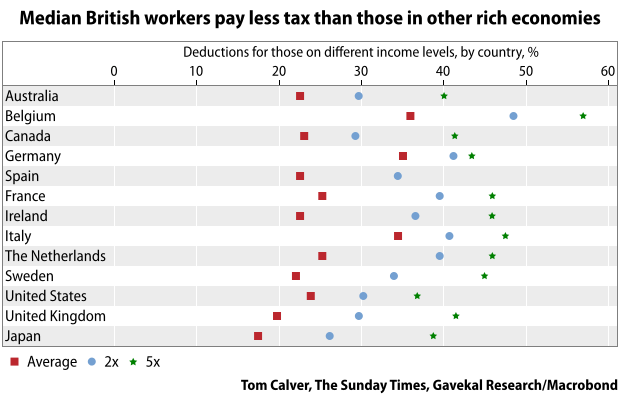
Clearly, the government faces a choice: either it needs to raise broad-based taxes on the whole population to deliver the level of public services and welfare that the country seems to want, or it needs to cut such spending significantly. Yet is any political party or leader ready to be honest about that choice? I see no appetite among Labour’s leadership hopefuls to make the case for higher taxes, only for more borrowing and more taxes on the already very narrow tax base of what it considers to be “the rich”. Similarly, the Tories now talk of cutting welfare spending but presided over a ballooning bill in office.
Meanwhile, the second pathology concerns Britain’s relationship with Europe. I won’t dwell on it here since I have written about it extensively recently (see The Overwhelming Case for Rejoin). The key point to note is that not only is the economic and geopolitical cost of Brexit likely to rise as the old global order disintegrates and the EU moves to deepen its own resilience and autonomy, but that none of the proposed half-way houses that dominate the UK debate will work.
Yet the statements on Brexit over the weekend by Andy Burnham and fellow leadership hopeful Wes Streeting do not suggest a willingness to confront this reality honestly. It is true that Streeting has said he thinks Britain should rejoin the EU “one day”, but his immediate goal appears to be a “special relationship” with the EU. That smacks of the kind of cake-ist delusion that has characterised the policy of British governments towards Europe for 70 years. Meanwhile, Burnham says he also wants to rejoin the EU one day, but won’t advocate it while he is fighting a by-election in a pro-Brexit constituency. The danger is that this kind of timidity raises unrealistic expectations and creates the conditions for disappointment and frustration with Brussels when they are not met.
The reality is that Britain needs to decide whether it prefers substantially lower public spending or substantially higher taxes, and whether it wants a far closer relationship with the EU, or a more distant one that would bring very significant new challenges in the form of new trade barriers. Without a government willing to reckon with these issues — and political leaders willing and able to make and win arguments — Britain will remain stuck in economic limbo. The country will surely continue to churn through prime ministers as politics fragments, populists continue to rise and separatist pressures grow.
Will a Labour leadership election bring clarity? I have my very strong doubts.
Sponsor content from Axa XL

The future of global investment depends on managing political risk. Are you ready?
Political Risk, Credit & Bond insurance may be little known, but it plays a critical role in enabling investment, trade and infrastructure development across the world.
In this piece, Rafael Docavo-Malvezzi from AXA XL explains how this market supports projects that improve energy access, water security and housing, and why managing geopolitical risk is key to driving sustainable growth.
Read the article - click link:

2. Gilty Verdict
The gilt market has already started voting on the Labour leadership contest, even if we don’t yet know when it will be held. Last week, 10-year yields hit a post-financial crisis peak of 5.1 per cent while the yield on 30-year debt reached its highest since 1998, reflecting investor fears about Labour shifting to the left under a new prime minister. Britain, which was once deemed one of the safest of havens, now has the highest borrowing costs in the G7.
True, the rise in yields has been a global phenomenon, but as Goldman Sachs notes, gilt yields remain notably elevated and have underperformed relative to other developed markets in recent years. The investment bank also argues that the sell-off has been predominantly driven by a repricing of monetary policy expectations rather than political factors. In other words, what is really spooking the markets is the expectation that Britain faces a bigger inflation shock from the Iran War that will force the Bank of England to raise interest rates.
The stickiness of UK inflation is an issue that has long puzzled economists. The Bank of England has only achieved its 2 per cent inflation target in four months out of the past 60, in contrast to the eurozone, which had already returned to target by October 2024. UK inflation was running at 3 per cent before the Iran war, compared to 1.9 per cent in the euro area. What’s more, inflation expectations have persistently run well ahead of the BOE’s target, suggesting households and businesses have little confidence it will be achieved.
Most explanations for this stickiness focus on current issues, including the preponderance of services in the economy to Britain’s reliance on spot gas prices to the effects of recent increases in regulated utility and transport prices. But the reality is that Britain’s inflationary tendencies are hardly a recent phenomenon: whenever there is a global inflation spike — think the 1970s and 1990s — Britain comes off worst. That suggests the problem is structural.
This deeper problem is rooted in Britain’s political economy. It is often said that Britain’s constitutional arrangements make it an “elected dictatorship” — the implication being that a government with a majority has a unique ability to do difficult things. In reality, Britain’s highly centralised state makes it particularly vulnerable to vested interests, so that hard decisions tend to get ducked. The result has been persistent failures to address supply-side challenges that might ease inflationary pressures such as energy, planning, housebuilding, transport, water and electricity infrastructure and pension reform.
One consequence of these inflationary tendencies has been that the British state has historically looked to external constraints to enforce discipline and enhance credibility. For much of the 19th and early 20th centuries, that meant a near-religious commitment to the Gold Standard. For the rest of the 20th century, it meant experiments with fixed exchange rate regimes of various kinds, culminating in Margaret Thatcher’s reluctant embrace of the European Exchange Rate Mechanism as her economic policy imploded. But since the humiliation of Black Wednesday in 1992, British governments have abandoned external restraints in favour of the domestic constraint of BOE independence.
Yet it is hard to look at today’s gilt yields and not conclude that this experiment has failed to deliver the promised stability. The markets clearly doubt the BOE’s appetite to bring inflation under control — and are surely right to do so. Far from acting as a constraint, the BOE has become a shield behind which governments hide, absolving themselves of their own responsibility for tackling inflation. No British government has delivered a budget surplus since 2001; the current one ran a deficit of 4.5 per cent of GDP last year in the middle of an inflation shock. The result is that Britain now has the highest cost of capital of any major economy — a huge drag on investment and productivity.
Nor can one necessarily blame the BOE for this. It has been placed in an invidious position. Given the shift toward longer fixed-rate household and corporate debt, bringing inflation down faster through monetary policy alone would require raising rates far higher and concentrating the entire cost of adjustment on a very small cohort of borrowers. It is a brave central banker who would risk that political fallout. The result, as I argued last year, is that the BOE enjoys a kind of qualified independence — operating within a zone of tolerance set by what the government can put up with (see Frightened Old Lady).
The optimistic view in the gilt market is that high yields will at least stop a new Labour leader doing anything really stupid. As Goldman Sachs put it:
A possible leadership change would increase uncertainty around the fiscal framework… but elevated debt levels and interest rate sensitivity are likely to limit the scope for significant deviation.
But not doing anything stupid is not the same as doing something sensible. Kaletsky reckons that such is the pressure on the government, that this could be a historic buying opportunity for cheap UK assets. But without tax rises and far-reaching supply-side reforms, the gilt market will continue to hang like a Sword of Damocles over Britain, leaving it one shock or policy mistake away from a deep crisis that could call the entire regime into question.
No monetary policy regime lasts forever, and as I have previously argued, there are compelling reasons to think the current one has not delivered even on its own terms (see Revolutionary Times). History suggests that sooner or later, the crisis will come and the search for a new external constraint will begin again. Perhaps that will be the moment that Britain seeks to join the euro? What a thought.
3. Winners and Losers
Writing about the Trump-Xi summit last week, I noted how China is dominating the industries of the future, including the observation that its AI models are now on a par with those of America (see Weak Hand). One reader pushed back, citing recent breakthroughs by Anthropic as proof that America still has the edge. The question of who is winning the AI race is important and was well examined in a recent episode of the New York Times “The Daily” podcast.
In it, Vivian Wang, the Times’s Chinese tech reporter, notes that China and America have adopted somewhat different approaches. From the beginning, China’s strategy has focused on real-world applications — putting the technology in people’s hands and in factories, using it to make the economy run better. On this score, China is probably ahead. In contrast, much of the excitement in America revolves around Artificial General Intelligence (AGI), the race to develop powerful superhuman intelligence. This is one America may be winning — assuming it can actually be done.
More broadly, America may have the edge on models, chips, innovation culture and access to talent, but China seems to be finding ways to minimise these disadvantages — as it demonstrated last year with Deepseek. Intriguingly, the report contrasts the high levels of enthusiasm for AI in China with a growing political backlash in the US and the West about the social consequences of where the technology might be heading, amid fears of mass joblessness. The ultimate winner may be whoever can best harness the benefits while managing the disruption.
Of course, Britain, with its deep reliance on knowledge sectors, may be more prone to disruption than most, in the form of rising joblessness, widening inequality and the erosion of its tax base — another issue hanging over the country that has barely begun to enter national debate. Very British problems indeed.
Surely, a start would be to make any news media operating in the UK legally bound to be geographically based in the UK, and taxed in the UK. I realise this would hit the best newspaper, the Financial Times, but such a move is likely to temper the misinformation deliberately spread by the Daily Mail, the Daily Express, and even the Times.Now that we know how Christopher Harborn, a crypto billinaire resident in Thailand, is funding the political party Reform, the idea of permanent present in the UK becomes even more attractive. Second step: taxation of land values, which would make some sorts of speculation more difficult.
Simon, thankyou for your comments on this issue here and last week. I am not a Labour voter but am very uncomfortable with what is happening for a number of reasons. First of all, I am old enough to member the Wilson governments Wilson was a very able man but faced the hostility of his own leftwingers; Ray Gunter, Ian Mikardo, Michael Foote etc. I think all of them were quite serious and sincere but really did not understand the huge problems of post-war Britain. Of course the right-wing press were also savage. Much the same was true of Blair although his charisma and unique talent went along with an exhausted Tory party and, in my view, some very talented colleagues to fill ministries. Now Starmer is facing the same attacks and I know some Corbynites who were never going to give Starmer a chance and I think their stance may be multiplied considerably throughout the country. What some of the right-wing press is prepared to write should ,I think, be regarded as treason and neither economics nor the truth has been a strong point for Farage. In addition, most voters, I think, just assume that blaming the preceding government is just what parties always do. That is correct but how many of them can genuinely assess how much damage Johnson and Truss left, let alone how enormous is the damage from Brexit. How many of them noticed in the Press that our economy in the first three months (the latest available) has actually outpaced our European competitors and the reality that NHS lists, though still very long, are falling and would fall more rapidly if doctors would refrain from strikes. In addition, I see very little discussion of how Starmer`s burden is increased by Putin in the East and Trump in the west. Would Streeting or Trump bring them to heel? I doubt it. So we are left with the complaint that Starmer has no charisma. Who has charisma and what do people mean by it. Farage can hold an audience but without offering any credible solutions I suppose by some definitions Johnson had charisma when not hiding in fridges. The other complaint is that Starmer has no "vision". I have no doubt he is clear about much of what is needed but do we want "vision"? Hitler, Genghis Khan, and Vladimir Putin all had vision. I`d say that is precisely what we don`t want. Sorry to have taken up so much space but I feel quite strongly about it and of course no one has to read it.